
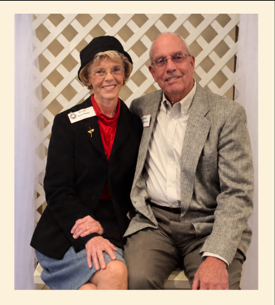
In December 1979, Ron and I got married in Chicago over Christmas break of our junior year of college.
We were twenty years old, which now seems ridiculously young to be making promises intended to last a lifetime.
I had my Farrah Fawcett hair, we had folding chairs, and the most wilted yellow flowers Chicago had ever seen. And somewhere in the middle of all of that, we stood before God and the people we loved and promised to stay together for better or worse, for richer or poorer, in sickness and in health.

I don’t remember what I thought in sickness and in health meant at twenty. Probably something involving the flu and chicken soup. I certainly wasn’t imagining hospital waiting rooms, the loss of a child, or a life-defining disease.
We were imagining a life together.
And that’s what we built.
The News We Never Expected
A few months ago, Ron signed up for some optional bloodwork almost accidentally. It was offered as part of our annual checkup, and we didn’t really expect anything from it. We’d paid for it, so we figured we might as well benefit from it.
Then the results came back, and there were some numbers on that report that we really didn’t want to see.
Now, Ron and I can Google with the best of them, but neither of us has a medical degree. So we tried not to get ahead of ourselves. Maybe the results didn’t mean what we thought they meant. Maybe there was another explanation. Still, we took them to our beloved GP with somewhat shaking hands and hearts that were trying very hard to hold steady.
Could this conceivably mean what we thought it might mean?
I don’t know if our doctor was just having an off day or if he was as surprised by the results as we were, but he looked at the report, glanced up at us, and could barely meet our eyes.
He didn’t even say the word.
“I know this is a difficult diagnosis to hear,” he said. “Let me get you some referrals.”
It was so subtle that Ron didn’t catch it.
He left the doctor’s office humming.
But I knew.
Not Our First Rodeo
Alzheimer’s was already a word with history in our family. My father died of Alzheimer’s, and my grandmother spent the la
st years of her life in memory care convinced the nurses were trying to pois
on her.
She didn’t know our names, but we always knew her.
I also knew Ron had his own genetic risk. Now something we had known about in theory seemed to be moving into our actual lives.
There were more appointments after that. More testing. More waiting. Eventually, we got the answer we’d hoped we wouldn’t receive.
Ron has early-onset Alzheimer’s disease.
Even now, typing that sentence and knowing I’m about to send it to thousands of people feels rather surreal.
We discovered it very early, and that’s important because if you spent time with Ron today, you probably wouldn’t know. Yes, there are memory issues, and some things make more sense in retrospect. But he is living his normal life and doing remarkably well. (And of course, he’s given me 100% permission to share this news with you.)
In fact, he can still wallop me regularly at Scrabble and Rummikub, which I find both reassuring and slightly irritating. He handles our finances like a maestro, keeping track of things that make my eyes glaze over after approximately thirty seconds. And he still makes me breakfast every single day.
That’s the Ron who has Alzheimer’s today.

I need to remember that because the word Alzheimer’s has a way of sending my mind racing into the future. It doesn’t take much. A doctor’s appointment, something I read, a moment when Ron forgets something he normally would have remembered, and suddenly I’m mentally living three or five or ten years from now, trying to solve problems that don’t exist yet.
We know where this disease can lead. We’ve seen it in our own family, and I don’t want to make that sound better than it is.
This is heartbreaking, life-altering news.
There are days when I’m afraid. We’re also very new at this. We don’t know how to have Alzheimer’s yet.
When You Don’t Know How to Do What Comes Next
Oddly enough, that feeling of standing at the beginning of a life you don’t know how to live isn’t entirely unfamiliar to us.
The hardest time, of course, was when our daughter Bethany died.
I remember sitting beside Ron in the front row of a church packed with more than a thousand people, holding our two micropreemie grandbabies who hadn’t even turned one yet, trying to comprehend the fact that we were at our only daughter’s funeral.
There are some experiences for which you simply have no category until they happen to you.
I couldn’t have imagined beforehand that a person could hurt that badly and still get up the next morning. I certainly couldn’t have imagined that there would come a day when laughter could somehow coexist with that grief.
But it did.

That experience doesn’t give me a map for Alzheimer’s, and our history with God doesn’t take away all the fear. What I have now, though, is something the twenty-year-old girl with the Farrah Fawcett hair didn’t have: a much longer history with God.
There were graces I needed after Bethany died that I could never have imagined beforehand. God didn’t give me years’ worth of strength in advance. He met us in the days as they actually came, sometimes in ways so ordinary we probably didn’t recognize them until later.
That matters to me now.
I’ve thought quite a bit lately about those two ridiculously young people standing in Chicago forty-seven years ago. The words in sickness and in health sound different to me now than they did at twenty.
I don’t know everything loving Ron through Alzheimer’s will ask of me. Ron doesn’t know everything this disease will ask of him. There are whole chapters of this story that haven’t been written yet.
What I know today is that this is our road, and the man I’m walking it with is still right here.
Staying in the Life We Have
That may be one of the things God is teaching me most tenderly right now: to stay here.
Alzheimer’s makes it very easy to grieve forward. You learn what might happen and begin emotionally living there. I’ve caught myself looking at the husband sitting across from me while simultaneously seeing some frightening version of the future that exists only in my imagination.
Meanwhile, today’s Ron is sitting right there. Tomorrow morning he’ll probably make me scrambled eggs with avocado on the side.
I don’t want to miss him because I’m busy bracing for a future that hasn’t arrived.
There’s a picture that has been coming to me as I’ve prayed about all of this. It’s the road to Emmaus.
Two disciples are walking along a road they never expected to be on, trying to make sense of a story that seems to have gone terribly wrong. And Jesus comes alongside them.
Lately, when I picture that scene, I sometimes see Ron and me walking that road. Jesus is there between us, and His circle of light surrounds the three of us. Beyond that light, the road disappears into darkness. We can’t see where it goes.
Maybe we don’t need to yet.
Knowing Jesus is with us doesn’t make me completely unafraid. I have peaceful days and harder ones. Sometimes I look across the table at the man I’ve loved for almost half a century and simply think, Oh, Ron.
We’re very new at this. For now, perhaps it’s enough to walk the piece of road we can see with Jesus.
Somewhere in these first weeks, Ron and I started talking about how we want to live now. Alzheimer’s will require attention. There will be appointments, decisions, and changes, and we’re going to do everything we wisely can to slow its progression and care for Ron well.
We also don’t want Alzheimer’s to become the organizing principle of our life.
There is breakfast. There are games to play and places we still want to go. There are people we love and ordinary Tuesday mornings that get to remain ordinary Tuesday mornings.
We don’t want to hand those days over to Alzheimer’s before Alzheimer’s has even asked for them.
So Ron and I have come up with a little phrase for the road ahead:
In the darker place there is greater grace.

We’re not calling Alzheimer’s a gift, and we’re certainly not expecting ourselves to find something beautiful in every hard thing that happens. This is simply where we’ve decided to keep looking.
There is joy here now, and I don’t want fear of tomorrow to make me miss it. And when tomorrow eventually asks something of us that today hasn’t, I believe there will be grace there too. I’ve lived long enough with Jesus to know that much.
My husband has Alzheimer’s disease.
And today, he is here.
We’re going to live this day.
One practical request before I close. We deeply welcome your prayers, your love, and your encouragement. Truly. At this point, though, we aren’t looking for additional medical suggestions, treatments, books, podcasts, or research. We have a medical team we trust and a plan we’re pursuing, and keeping our focus there is one way we’re caring for ourselves right now.
Your prayers and love mean more to us than you know.
If you’d like to hear more, today’s episode of The Pace of Grace is a much more personal conversation about Ron’s diagnosis, our forty-seven years of marriage, and what those old words in sickness and in health mean to me now.
LISTEN TO: The Diagnosis We Didn’t Want to Receive
There will be times when I’ll share pieces of this journey with you when it seems helpful and appropriate.
For now, there is still so much life to live.
And we’re going to live it.
0 Comments